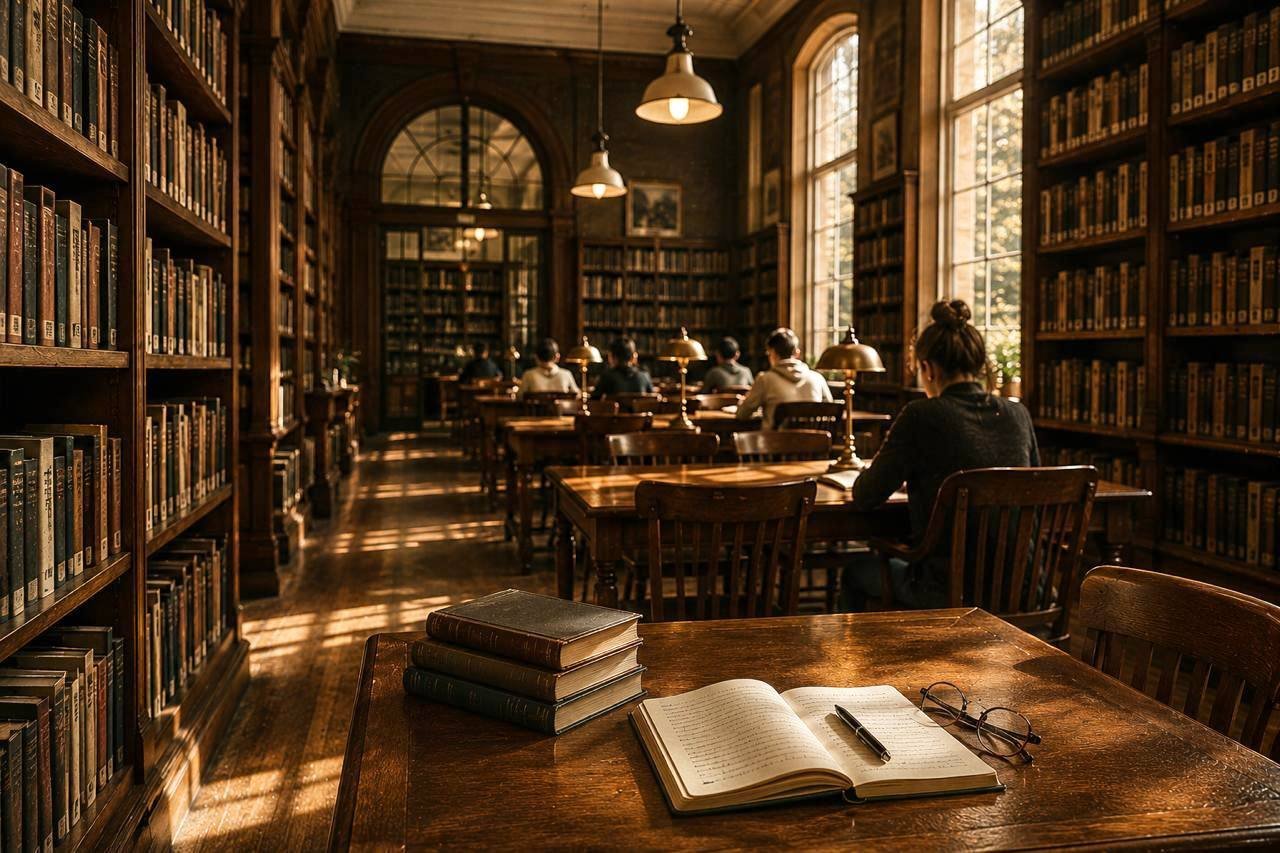
They say you can’t judge a book by its cover, but I believe you can judge a soul by the way their eyes light up when they walk into a library. There’s something almost sacred about that moment when you push open those heavy doors and breathe in that distinctive scent – vellichor, they call it. The smell of old books, of stories waiting to be discovered, of wisdom that has been quietly aging on wooden shelves.
I remember the first time my mother took my hand and led me through those towering aisles. I was just a child then, overwhelmed by the sheer magnitude of knowledge surrounding me. The woody mist seemed to dance between the pillars, and the rusty pages whispered secrets I was desperate to understand. I didn’t know it then, but that single moment would change the entire trajectory of my life.
School was never my sanctuary. The corridors echoed with laughter that never included me, and the playground felt like a battlefield where I was always the last one standing – alone. But books? Books were different. They welcomed me with open arms, offering refuge when the world felt too harsh, too loud, too overwhelming. In those pages, I found friends who understood my quiet nature, characters who spoke to the parts of me I couldn’t yet articulate.
What I didn’t realize at the time was how my loneliness was slowly transforming into something beautiful – solitude. There’s a profound difference between the two, though it took me years to understand it. Loneliness aches; it’s the feeling of being disconnected from the world around you. But solitude? Solitude is a choice. It’s finding peace in your own company, discovering that being alone doesn’t mean being lonely.
Books taught me to embrace this solitude. They showed me that some of the most beautiful moments happen when you’re curled up in a corner with nothing but words for company. The characters became my companions, their struggles my own, their victories a source of quiet joy. I learned that reading wasn’t just about consuming stories – it was about living them, breathing them, becoming part of something larger than myself.
The magic of literature isn’t just in the stories themselves, though they are undeniably powerful. It’s in that moment when you realize you’re trying to read life between the lines. Every pause between sentences holds meaning. Every carefully chosen word carries weight. The spaces between paragraphs become pregnant with possibility, and you find yourself searching for the author’s soul in the rhythm of their prose.
I was endlessly curious about this magic. How could simple words and phrases hold such power? What made one combination of letters capable of making me cry, while another could lift my spirits to impossible heights? These questions consumed me, driving me deeper into the world of literature, always seeking to understand the mechanics of the miracle I was witnessing.
The library became my second home – perhaps my first, if I’m being honest. I knew every section by heart, could navigate the maze of shelves with my eyes closed. The librarians smiled when they saw me coming, already knowing I’d leave with arms full of books, my hunger for stories never quite satisfied. I was a regular fixture in that quiet corner by the window, sunlight streaming across pages that had been turned by countless hands before mine.
What struck me most was the intimacy of reading. Here I was, alone with an author’s thoughts, privy to their innermost musings. They had poured their hearts onto these pages, and I was drinking it all in, one word at a time. It felt like the most beautiful conversation – one where listening was just as important as speaking, where understanding happened in the spaces between breaths.
Somewhere along this journey, something shifted. I stopped being just a consumer of stories and started becoming a creator of them. The inspiration struck quietly, like dawn breaking over a sleepy town. I found myself reaching for a pen, wanting to capture the emotions that books had stirred in me. I wanted to create my own worlds, to offer the same sanctuary to others that literature had provided for me.
Writing became my way of giving back to the universe of stories that had saved me. Every sentence I crafted was a love letter to the books that had shaped me. I wrote about emotions because literature had taught me to feel deeply. I wrote about mental health because books had shown me that vulnerability was strength. I wrote about solitude because I had learned that being alone with a good book was one of life’s greatest pleasures.
The transition from reader to writer wasn’t dramatic – it was as natural as breathing. One day I was absorbing stories, and the next I was creating them. The boundary between the two had dissolved so gradually that I hardly noticed it happening. But looking back, I can see that it was inevitable. When you spend your days immersed in the craft of storytelling, when you study the way words can dance and sing and weep, eventually you want to join the conversation.
Now, when I walk into a library, I feel that same sense of wonder I experienced as a child, but it’s layered with something deeper. Gratitude. These books didn’t just entertain me – they raised me. They taught me empathy, showed me different ways of seeing the world, and ultimately led me to discover my own voice.
There really is no going back once you step into a library. But why would you want to? In a world that often feels chaotic and disconnected, libraries remain sanctuaries of quiet contemplation. They’re places where loneliness transforms into solitude, where curiosity blooms into understanding, and where readers sometimes discover they’re writers too.
The magic is still there, waiting on every shelf, between every line, in every vellichor-scented breath. And I’m still there too, forever grateful to my mother for taking my hand and showing me the way home.
